eBooks available

My 3 books and my entire collection of essays are now available in eBook format for a limited time. Special offer prices are also available.
Here is the link:
http://beautiful-landscape.com/Ebooks-Books-1-2-3.html


Artistic License

Artistic License
by Alain Briot
 Art is the product or process of deliberately arranging items
(often with symbolic significance)
in a way that influences and affects one or more of the senses,
emotions and intellect.
Wikipedia
1 – Introduction
A few years ago I wrote and essay titled Just say Yes.  The purpose of this essay was to …

Vision

Vision
Vision starts with personal taste. It starts with a conscious awareness of what you like and don’t like. One of the first exercises you can do is make a list of what you like and don’t like in photography and which photographers you like and dislike.
Vision is about your personal …

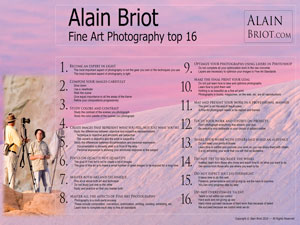
Fine Art Top 15

The most important aspect of photography is not the gear you own or the techniques you use. The most important aspect of photography is light.

Recent Articles:

Artistic License

January 5, 2012 Art 7 Comments
CF007182

Artistic License

by Alain Briot

 Art is the product or process of deliberately arranging items
(often with symbolic significance)
in a way that influences and affects one or more of the senses,
emotions and intellect.
Wikipedia

1 – Introduction
A few years ago I wrote and essay titled Just say Yes.  The purpose of this essay was to provide an answer to a question myself and other fine art photographers are asked repeatedly: do you manipulate your work?  In this essay I proposed that rather than argue endlessly and often fruitlessly about why we ‘manipulate’, we could simply answer ‘yes.’  Doing so answered the question and made the point that manipulation was an essential aspect of our work.

The purpose of the present essay is not to go back over this subject since I covered it extensively already.  Instead, my purpose is to cover something that I did not address in my previous essay and that is the reasons why we manipulate.  The point that I want to make is that we do not manipulate just because we feel like it.  Rather, we manipulate because manipulation is how we express our artistic license.  In other words, manipulation is a fundamental aspect of art.  In fact, we could say that manipulation is art, or conversely, that art is manipulation.

This concept is present in the word art itself.  Art is the prefix of words such as artifice or artificial.  These words point to the transformation created by the artist when going from reality to art.  Art is not real.   Art is an artifice, an invention, the product of the imagination and the creativity of the artist.  In short, expecting art to faithfully duplicate reality is a misconception, a misunderstanding of the very purpose of art.

The expression ‘artistic license’ says it all.  Artists are granted a license to manipulate reality.  This license consists of a large amount of freedom they can use to express themselves, to demonstrate their vision and share their emotions. However, one has to know how to use this artistic license. What is it exactly?  How do you use it?   How far can you go with it?

The Watchman, Zion National Park

 This photograph is a collage of three horizontal images taken with a super wide angle lens.  I could not have created this image with a single capture.  After stitching, I distorted the image to enlarge the foreground rock and also to increase the height of the Watchman, the mountain peak at the center top of the image, and make it more dominant and impressive.  I often say that if the National Park Service wanted to use my images in their brochures or displays they would first have to agree that my images would not show what people can see by themselves in the park.

2 – Different purposes
Photography has many purposes and this is at the root of the confusion some people experience in regards to the purpose of fine art photography.  Photography can be used to to create a visual record of documents and objects, it can be used as evidence in forensic investigations and in scientific research, it can be used in commercial photography to record weddings, to create portraits, to photograph products, architecture or fashion, to create art, and for a variety of other uses.

For example photographs used in forensic investigations, police work, court proceedings or scientific research are held to the highest standard of truth and accuracy in their depiction of the subject.  These photographs are documentary in nature and have no use for artistic license because their purpose is to record objects, events and locations in a factual manner.  To have value these photographs must be devoid of any kind of artistic interpretation and manipulation.  When creating these photographs the goal is to create a visual record in which the role of the photographer is limited to pressing the shutter.  In fact, in some instance the photographer is bypassed altogether and a machine is used to take the photograph.  This is the case in scientific recording when microscopes or other imaging devices are used.

Commercial photography such as product, fashion and architectural photographs are not held to the same rigid standards as forensic and scientific photography.  However, commercial photographs must still represent the subject faithfully.  Because these photographs are often used in advertising, it is essential that the audience recognizes the subject depicted in the images.  If the colors, shapes and other significant attributes of the subject are altered beyond recognition, the advertising will be ineffective because potential buyers will not be able to identify the product.  Therefore, while a certain artistic input is called for, there is a limit as to what the photographer can do.  Usually, this means using lighting, composition and location as variables to express a personal style.  Beyond that, things like changing colors or altering the shape of the products dramatically are simply out of the question.

Wedding and portrait photography do call for a certain amount of artistic license. In fact, clients select a specific wedding or portrait photographer largely because of his personal style.  This personal style, which is the implementation of artistic license in the work of a specific photographer, is what makes a photographer stand out among other photographer.  It is an important aspect of salability and therefore of commercial success. However, this personal style can only go so far.  Here too, just like with product, fashion and architectural photography, the subject, the people photographed, must be recognizable.  The bride’s gown has to be white (or whatever color it is in reality), the wedding participants have to be recognizable, and the people who sat for their portrait have to be shown in such a way that they are pleasing to look at.  In other words, clients must be shown in a positive way. They must look good!  Artistic license has its place in this type of photography, but it faces severe limitations.  Go beyond these limitations after being hired and you will not be paid.  Go regularly beyond these limitations and no one will hire you.

Many of the conflicts and difficulties that photographers experience come from not having clearly defined the purpose of their work. For example, if you want to submit your work to travel magazines, creating images that faithfully represent reality is important.  Travel magazine readers want to see images that realistically depict the places they plan to visit. They are not interested in artistic interpretations.  On the other hand, if you create realistic images it will be challenging to develop a personal style because artistic interpretation is one of the most significant ways of making your work unique.  Some artists do succeed in ‘straddling the fence’ by finding a way to be faithful to reality while using a certain amount of artistic license.  However, while this approach is satisfying to some for others it falls short of allowing them to use artistic license to its full potential.


Knotted Stream, Death Valley National Park

The knot-like appearance of this stream on the Death Valley Playa is what caused me to take this photograph.  However, back in my studio I realized that there were other streams that interfered with the visual knot-like effect.  I therefore decided to clone and heal these unwanted streams until I was left with the image I saw in my mind’s eye when I took the photograph.  While this image no longer shows what was really there, I consider it to be believable in the sense that it shows something that could exist.  Plus, it is certainly far more visually captivating that what was actually there. The problem with reality is that it is often far too real.  I use artistic license to make reality less real and more dream like.

3 – No contract
These different purposes, and the limitations they come with, contrast sharply with the purpose and ‘limitations’ of fine art photography. I say ‘limitations’ because in fine art photography there are none.  In fact, one of the purposes of fine art photography, which is similar to that of other fine arts, is to remove limitations so that the artist is free to create whatever he or she wishes to create.

This is possible because of the absence of a contract between the artist and his clients.  I am asked frequently if I consider the selling potential of a photograph in the field, at the time of capture. I don’t because I don’t need to.  Unlike a wedding, portrait, product, fashion or other commercial photographer, I do not work under the umbrella of a contract that calls for the creation of specific photographs.

While a product, wedding, portrait, fashion etc. photographer enters into a contract with a client prior to taking the photograph and must create photographs that meet his client’s desires, a fine art photographer creates images and looks for clients afterwards.  The two processes, when it comes to selling, are inverted.  While a product, wedding, etc. photographer is paid because he fulfilled his client’s request, a fine art photographer is paid because he expressed something unique that interested buyers relate to emotionally.

4 – Expression, not documentation

There are also significant differences in regards to the goals of fine art photography.  While the goal of most types of photography is to document reality, with or without creative license, the goal of fine art photography is to provide an outlet for the creative expression of the artist.

As a fine artist I have little interest in documenting reality as it is around me.  I see reality everyday and the last thing I want to do is to create reality-like images to hang on my walls.  If I want reality all I need to do is look out of the window.  Therefore, when I create art my goal is to create something other than reality.  My goal is to express myself without much concern for whether or not what I am depicting in my photographs is real or not real.  In fact, when asked about this aspect of my work, I tell customers that if it turns out that the photograph they are purchasing from me is 100% real they will get their money back.  I use this tongue in cheek remark to remind clients that this is art and that art is about the artist’s view of the world, not about reality.  Reality is there for the taking.  My clients can capture it just as well as I can.  But at the same time, I find reality boring.  There is simply nothing unique or original about it.  What is original is interpreting reality and creating expressive images that depict a personal view of the world. Only by doing so can I make the best use of artistic license.

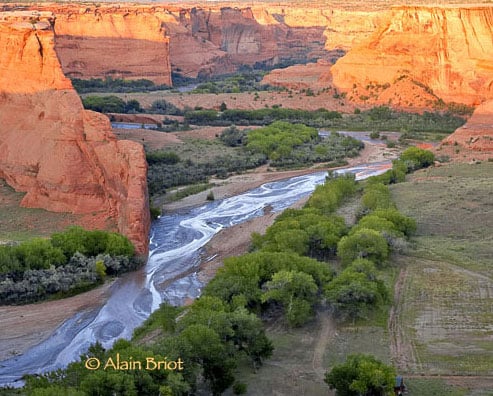
Side-Lit Trees at Sunrise, Canyon de Chelly National Monument

This image of Canyon de Chelly is a collage of two horizontal photographs taken with a short telephoto lens.  After stitching I realized that the arrangement of trees that constitute the main interest of the image was not pleasing to me.  Some trees were located too close to each other, and one tree touched the right edge of the image.  I therefore decided to clone, remove and relocate the offending trees until I created an arrangement that I found to be visually satisfying.

5 – No right and wrong
In art there is no right and wrong.  Art is up to the artist, his emotions and his inspiration. To be ‘right’ a work of art only needs to meet the artist’s taste and expectations.  Furthermore, if art is ‘wrong’ if somehow the piece does not ‘work’ there is no penalty.  At worse, the audience will dislike it. In all likeness, some will dislike it while others will like it.  This is because art is a matter of personal taste and opinion and in art opinions are always polarized. People tend to like or dislike a work of art.  They don’t see shades of grey. Instead, they take black and white positions. This is because art is emotional, both on the the artist’s side and on the audience’s side.

Unlike a machine, art does not have to “work” the way a bridge, a car, or some other engineered device has to work.  If a bridge is not designed properly it may collapse or suffer some other form of structural failure.  In art, failure is of an aesthetic nature,  not of a practical nature. Failure in art is in the eye of the beholder.  If art fails, nobody gets hurt.This is why scientists, engineers and others who practice a technical profession before turning their attention to art often find creating art challenging.  Their training taught them that to be successful in their profession they need to create things that work, things that are properly engineered, things that have been tested and that are known to stand up to the task for which they were engineered.  Fine art is artistic sensibility combined with technical precision. While they excel at technical precision, they find including artistic sensibility in their work a challenge.

Tires, to take but one example, are designed to reach a specific speed, carry a specific weight, and withstand a specific amount of heat and lateral forces among other constraints.  Tires are designed with specific cars in mind and different tires are used on different types of cars.  For example, the construction of a tire designed for a Ford Econoline passenger van is radically different than the construction of a tire designed for a Bugatti Veyron.

Mounting the van tires on the Veyron is asking for trouble.  Most likely they would not fit.  However, if we can somehow make them fit, before the Veryon reaches its maximum speed the tires will explode or come off the rim, creating an engineering disaster.  On the other hand, if the proper tires are used on the Veryon, no such thing will happen.  This is because Michelin, the manufacturer of the Veyron tires, has engineered tires specifically for that car.  The tires have been designed to withstand the specific forces, heat, weight and speed created by the Veyron.  They have been tested to specifications that exceed the actual forces imposed by the car at maximum speed.  Unless a catastrophic failure caused by an external element (debris on the road for example) occurs, the tires will perform the job they were designed to perform to perfection.  In fact, they will be performing under their maximum abilities because they have been over-engineered and can withstand forces higher than what the car can impose on them.

There are no such concerns in art.  If art fails no one gets hurt. Tire failure on a Bugatti Veyron traveling at maximum speed will result in total destruction of the vehicle and possibly death of the driver.  Artistic failure with a work of art will only result in negative reviews or with a displeased audience, if that much. In fact, if you are not well known, it is likely that no one will notice.  Because what constitutes good art is a matter of personal taste, what may be an artistic failure to some may be an artistic success to others.  In art, unlike in tires, bridges, or other types of engineering, no one gets physically hurt. Only egos maybe bruised, and even then not always and if so not necessarily for a long time.  Art is the domain of freedom.  Art is where one can take risks without exposing themselves to physical harm.

6 – Your art is about you
Art is about yourself, not about others.  What you do in your art is controlled by you, not by outside forces.  Art is not subject to rules and regulations the way other professions are.

For this reason it is important that you create work that pleases you.  As long as you create art to please others, what you are trying to do is impress these other people. The minute you create art with the goal of pleasing yourself, you start to work towards impressing yourself.  At that time your goal becomes to express what you feel, who you are and how you perceive the world.  You no longer care if someone will be impressed or will like what you are doing.  This is when you begin to use creative license to its full potential.

Mauve Playa, Death Valley National Park

In this image, an horizontal collage of two images, I purposefully tuned the color palette towards a collection of mauve tones.  The original colors clashed with each other and were visually underwhelming.  Shifting colors towards a mauve palette, together with some warping and stretching of the foreground elements, allowed me to create an image that is visually coherent in terms of both colors and shapes.

7 – Answers
Art is a question to which there are many answers. You are the one who decides what the correct answers are. No one else has the right, or the authority, to find those answers for you. The test of art is not whether your work is right or wrong.  The test of art is whether your work is unique to you or not and whether it expresses the emotions you want to share with your audience.

To find accurate answers you need to decide what you consider to be acceptable and inacceptable in your work. By doing this will you will define a space where you are free to create what you want.

However, this space will have boundaries. Those boundaries are set by what you decide you will and will not do. All artists have to do that.  By deciding to do cubism, Picasso decided to not do Realism.  By deciding to do Minimalism, Jasper Johns decided not to do Hyper Realism.  There is no way out of this process.  If you do not set boundaries, you will be doing ‘whatever’ and ‘whatever’ will not lead to the creation of a body of work unique to you.  Instead, ‘whatever’ will lead to ‘whatever’.

Following this process will, gradually, lead to the development of a personal style.  This will happen through the development of an artistic space defined by your personal taste and preferences, by what you decide to show and not show in your work, and by what you want to focus on or ignore. This artistic space is where you are free to express what you want.

8 – Content and meaning

Artistic license extends to the content of your work. Your vision, what you decide to show to your audience, is entirely up to you.  Regardless of what you do there will be people who, based on what you show in your work, will consider your work to qualify or not qualify as being fine art.   The point to keep in mind is that the content and the meaning of your work are part of artistic license and as such are fully under your control.

When considering content as one of the aspects of artistic license it is important to know that there are ‘fashion trends’ in art. For example a number of high end galleries and museums tend to favor a postmodern, socially critical and relatively negative content.  This is, for example, in opposition to my work which is focused on exploring natural beauty, positive in its message and not containing postmodern references. I could easily have taken a more ‘fashion oriented’ approach and decided to create images of nature that focus on ugliness and negativity and that contain postmodern references.  In fact, if you look at contemporary French art and culture, doing so would be expected of me since I am originally from France and have extensive knowledge of postmodernism having read just about every author who published on this subject while I worked on my PhD.  The fact I chose not to go in this direction is a personal decision rather than a cultural shortcoming.

What this implies is that here too you will encounter people who like and dislike what you do.  Continuing with my personal approach to landscape photography, while some consider ‘beauty’ to be a qualifier for fine art, others consider it a disqualifier.  The same holds true for postmodernist content as well as for political, negative, positive, social commentary and any other content.  Ruling out specific content has an adverse effect on artistic license.  If we ruled out ‘beauty’ as a qualifier for fine art, we would by the same token rule out Impressionism as a valid art movement.  What a shame that would be.  Beauty is an essential component of art, even though a number of people today consider it to be a disqualifier.

Clearly what content the artist decides to feature needs to be based on the artist’s inspiration, personal taste, philosophy, message, vision and so on.  There will, and there are, massive differences between artists in this regard.  These differences are one of the main attractions of art.  More importantly, the choices you make in this regard are fully part of your artistic license.

Using meaning as a qualifier for fine art is even more superficial than using content.  What is meaningful to some is meaningless to others.  For example, some  find Cubism totally devoid of meaning while others consider Cubism to be one of the most important movements of the 20th century and consider Cezanne, whose painting Maisons a l’Estaque (1908) is at the origin of the term Cubism, to be one of most important artists of the 20th century.

9 – Defending
There are times when artistic license needs to be defended.   Just saying yes only works when people ask you if you manipulate.  If the questions is more precise, if it points to a specific aspect of your work, a more detailed answer is necessary.

For example, I have been asked what is my position in regards to the fact that realistic photographs of nature have played an important role in nature conservation efforts, for example in helping create National Parks and pass legislature protecting natural areas from development.

My answer to this specific question is what started me doing landscape photography was not the desire to raise awareness about the importance to protect nature. Instead, it was the desire to create art that expressed my vision of natural beauty. There are plenty of photographers out there who are doing a fantastic job of bringing awareness to nature conservation and I let them take on that responsibility. Personally, my goal is to express myself and provide my audience with images that convey a vision of nature not available elsewhere.

In that regard I may be distancing myself from the main direction taken by landscape photography and getting closer to non-photographic art medium such as painting. This is a personal decision based on the fact that not all art has to be representational. In fact, most art is not representational.

I have also been asked why should people care about images that do not show something real? My answer is they care for the same reasons people care about art movements that do not represent reality. Surrealism, Cubism, Fauvism, etc. are popular movements even though they are not about representing reality. To some extent, Impressionism, a movement in which nature is one of the main subject, is not about representing reality but rather about presenting an impression of reality. Photography certainly had a large following of practitioners who made it a point to represent reality faithfully, but then again when that reality is presented in black and white, or with a contrast ratio much higher than what we see with our eyes, or with extensive darkroom or digital adjustments, even though no removal of objects or distortion of the image were performed, one can question how real that reality is. In fact, Susan Sontag in On Photography makes the point that photography is by nature surrealist, not realistic, and she is talking mainly about straight photography.

The number of questions you can possibly be asked being endless, providing an extensive list is futile.  The whole idea is that at times you will have to defend yourself by describing your personal goals.  Who cares if I am not following the conservation movement, or if some people lose interest in my work because it is not ‘real’. What matters is that I am doing what I love, that I create work that is unique and that collectors purchase my work and enable me to make a living doing what I love.

10 – Stylistic Variety
Finally there is the issue of stylistic variety in one’s work.  In the days of film, having a variety of styles was challenging because changing photographic styles involved changing camera equipment, film processing, printing and other variables.   For this reason most photographers adopted a style and used it all their life. A few had a couple of styles, usually one for commercial work and one for fine art work, and that was it.

Digital capture and processing removed most of these hurdles.  Digital processing allows us to process the same photograph with a variety of styles.  The question no longer is how do I create a different style, the question is how many styles do I want.  Photographers who explore digital possibilities are more likely to have issues with offering too much diversity than too little.

The fact that stylistic variety is no longer a challenge makes it possible for photographers to create different bodies of work each with different approaches.  For example, last year in addition to landscape images such as the ones used as examples in this essay, I created a series of car photographs, a series of layered images, and a series of reportage style images.  Each of these series used a different approach.  The car photographs were processed entirely in Lightroom using global and local tinting, gradients and vignettes.  The layered images were processed in Photoshop and made use of multiple colored texture layers giving them a grunge look.  The reportage photographs were processed in Lightroom and had hardly any processing done to them besides color balance and density adjustments.  These series were done in addition to my landscape work, which remains my primary activity, and received only minor advertising on my site. The goal of these series was to change my mind by doing something new and different.  However, taken as a whole, these different series make it challenging to decide what my approach is because each series is treated differently.  For this reason it is best to say that creating different series of images, each with its own unique treatment, is another aspect of artistic license.  One doesn’t need to use the same style all the time.

11  – Conclusion
When you purchased your camera and decided to use it for the purpose of creating art you gave yourself license to do what you like and to have fun with it.  In other words, you gave yourself artistic license to do what you like.  Unless you are under contract and have to please a client, use your artistic license to have fun with your work.  This is your money, your time and your efforts and if you are not doing what you like something is not going right.  Remember that in art you can never please everyone, so let others think what they may.  There will always people who will praise what you do as long as your work expresses what you feel and is unique to you.

About Alain Briot
Alain Briot creates fine art photographs, teaches workshops and offers DVD tutorials on composition, image conversion, optimization, printing and marketing. Alain is the author of Mastering Landscape Photography. Mastering Photographic Composition, Creativity and Personal Style and Marketing Fine Art Photography.  All 3 books are available in eBook format on Alain’s website at this link: http://beautiful-landscape.com/Ebooks-Books-1-2-3.html

You can find more information about Alain’s work, writings and tutorials as well as subscribe to Alain’s Free Monthly Newsletter on his website at http://www.beautiful-landscape.com To subscribe simply go to http://www.beautiful-landscape.com and click on the Subscribe link at the top of the page.  You will receive information on downloading the table of contents, plus over 40 free essays by Alain, immediately after subscribing.

Alain welcomes your comments on this essay as well as on his other essays available. You can reach Alain directly by emailing him at alain@beautiful-landscape.com.

Alain Briot,
Vistancia, Arizona
January 2012

Can you sell my work ?

October 26, 2011 Marketing No Comments

Can you sell my work ?

I regularly receive emails from photographers asking me if I can sell their photographs.  Typically these emails read like this: “I have a fantastic photograph of  (insert location here), I know it’s worth a fortune (millions usually), I just need help selling it.’  Some offer to ‘take me in’ as a partner for a share of the profits (no thanks), others just want the email of the ‘magic person’ who is going to make them rich (there’s no such person).

Sorry folks, but none of this will work.  You don’t make money in photography because you believe, rightly or wrongly, that you have a ‘million dollar’ photograph.  You make money in photography because you have learned how to market and sell your work yourself.

Don’t forget this:
A bad photograph well marketed will always outsell a good photograph poorly marketed. Alain Briot

This means that it doesn’t matter if you have a ‘million dollar’ photograph if you don’t know how to market it.  Someone else, with a $100 photograph but with photography marketing knowledge, will outdo you financially.  Of course, the goal is to have a great photo and fantastic marketing knowledge. However, to get started what you need first is marketing knowledge.

Many photographers who start selling their work are trying to find someone who is willing to sell their photos and make them wealthy.  I know everything about that because I was one of these photographers.  I looked everywhere for such a person but did not find it. It was during this fruitless search that I understood I had to  learn how to sell my work myself.

I realized that finding a person willing to make me rich was simply not going to happen. I had to do that myself.  I succeeded because I learned how to control my destiny.  Instead of asking others to make me rich, I went out and made myself rich.  14 years ago I had nothing.  Now I have more than I ever dreamed.  The photograph at the top of this essay paid for my first house cash.  I made every sale by myself after learning how to market and sell my work.

I studied at the school of hard knocks.  I did not take marketing classes and I did not study for an MBA.  My experience is practical, not theoretical.  It comes from the trenches, not from books.  Learning that way wasn’t fun.  I decided to write about and teach marketing to offer you a better way to get this knowledge.  By sharing my knowledge with you I can teach you how to do what I do. It starts by taking the decision to control your own destiny instead of looking for someone (or something, such as luck or the lottery) to make it happen for you.

My no-nonsense approach to teaching marketing is  based on my personal experience, not on books or college classes.  I teach you how to do what I do.  I have no secrets because I believe that there are opportunities for all of us out there.

Whichever way you do this, either with me or someone else, you are going to have to learn marketing.  There’s no way around it. There’s no silver bullet and you won’t get rich overnight.  Things moved fast for me, but it still took me 4 years of constant work to be successful.

Anyone that tells you otherwise is either lying or delusional.  Why?  Because if it was that easy, if there was a silver bullet and if we could become millionaires overnight, we would all be doing it!  Everyone would be ‘rolling in the dough’ living in big houses, retiring at 40 and driving Bentleys!  It’s far from being that way because being successful is uncomon. It’s also a lot of work.  Only those who learn how to do this and who are willing to work as hard as it takes succeed.  I had to do it that way. All those that are successful in this business have to.

I just announced my new Advanced Marketing Seminar.  This is the perfect place to learn how to do this and to make your dreams happen:
http://beautiful-landscape.com/Workshop-Marketing-Advanced%20-2012-1.html

If you are not ready for the seminar, start by reading my book on marketing:
http://beautiful-landscape.com/Ebooks-Books-1-2-3.html

Either way you will be moving forward towards your dream.  Just keep in mind that you are the one who will make it happen.

 Alain Briot

Marketing Photo question – answer

October 20, 2011 Marketing 2 Comments

1 – Question:
“I have some opportunities to have some of my work shown at a couple of City Hall and similar venues. Am wanting to know if others have done this and if it is a good way to sell prints?”

2 – Answer:
Any venue where the public is invited has the potential of being propitious for sales. However, it is important to keep in mind these pointers:

1 – Has there been art shows organized there previously?
2 – If yes, how successful were these shows?
2 – Is this a public show where you actively sell your work (such as a street show or similar) or is it an exhibit where you hang your work and ‘hope for the best?’
3 – The venue is only one of several elements in defining your eventual success or failure.
4 – In the light of the previous remark, how much experience do you have with marketing and salesmanship?
5 – Do you have a ‘VIP’ list of collectors you can personally invite to the show?
6 – Is your work and pricing structure appropriate for this venue?
7 – Will the organizers advertise the show or is this up to you?
8 – Will the organizers want a cut of your sales, and if yes is their cut agreable to you or excessive?

3 – Advanced Marketing Seminar:
I will be offering an Advanced Marketing Seminar in Spring 2012.  A pre-registration list is opened with a special registration price offer.  To get on this exclusive list email me at alain@beautiful-landscape.com with the words ‘advanced marketing seminar’ in the subject line. There is no obligation, you’ll just be first notified and you’ll have save money when you register.  It’s all good.

Alain

A visit to Michael Stoyanov’s Gallery

September 28, 2011 Art 1 Comment

Yesterday we visited Michael Stoyanov’s gallery in Scottsdale, Arizona.   Michael is a friend and we own six of his paintings.  Here are some photographs taken during our visit:

Natalie and Michael.  We brought a small painting we purchased a while ago and Michael framed it for us.

Natalie admiring Michael’s ‘Masterpiece.’ Read my book, Marketing Fine Art Photography, to find out what I mean by ‘Masterpiece’. Hint: it’s not what you think.


Natalie ‘painting’.  We couldn’t help but have fun pretending to complete one of Michael’s painting.

A view of Michael’s Gallery.  Lots of artwork!


Alain Briot
September 2011


About eBooks

September 2, 2011 Marketing No Comments
Briot-ebooks

About eBooks

I recently started offering my books as eBooks.  This decision was motivated by the fact that for many people eBooks are now the primary choice when it comes to books. While I personally prefer physical, printed books, there are a number of advantages to eBooks:

- eBooks do not take any physical space.  100 eBooks on your computer take no physical space.  they only occupy disk space and not that much of it either.  The same number of books in a library will fill a shelf or two.

- eBooks do not consume trees.  While more and more books are now printed on recycled paper, paper, in any form, involves cutting down trees at some point.

- eBooks can be read on a variety of devices. Long gone are the days when eBooks could only be read on a desktop of laptop computer.  Today cell phones, iPads and a growing number of tablets and eReaders let you read eBooks anywhere.

- you can carry your entire eBook library with you anywhere.  No need to make a selection.  Just take everything and make a selection later on.

- eBooks are less expensive than physical books. In a challenged economy this is definitely an advantage.  While we do need to continue learning, we can do so at a lower cost.

Good things can be said about physical books too.  As I said, I personally prefer physical books.  For one, while they cost more, you don’t have to buy and upgrade an electronic device to read them and you can read them without being concerned that the batteries will go dead.  While they are heavier, you can write in the margins, notch pages and insert things between pages.  While these practices have digital equivalents, they just don’t feel quite the same to me.  While they take more space, they are also decorative.  There is an undeniable pleasure in owning a physical copy and in having a physical library.  Finally, physical books are collectible.  While no investment can be guaranteed 100%, rare, signed and limited edition books do appreciate in value over time.

In the end which of the two you prefer is a personal decision.  At least now you can have one or the other, or both.

If you haven’t yet you can order eBook versions of my three books at this link:

http://beautiful-landscape.com/Ebooks-Books-1-2-3.html

Enjoy

Alain Briot

PS- If you find advantages to eBooks or physical books not mentioned in this essay, post a comment.

Sketching

September 1, 2011 Uncategorized No Comments

A new Sketching Gallery is available at this link.
http://beautiful-landscape.com/Portfolios-Sketching.html

This gallery features sketches I created over the past couple of months and photographs of Natalie and I sketching.

The September 2011 Print of the month features one of my favorite sketches from this period. You can see it at this link:
http://beautiful-landscape.com/Print-of-the-month-102.html 

eBooks available

August 25, 2011 Art, Technique No Comments

My 3 books and my entire collection of essays are now available in eBook format for a limited time. Special offer prices are also available.

Here is the link:
http://beautiful-landscape.com/Ebooks-Books-1-2-3.html


August 2011 Newsletter available

August 6, 2011 Art No Comments
The August 2011 Newsletter is available at this link:http://tinyurl.com/3o2f6cnIf you are not a subscriber yet you can subscribe for free on my site at http://www.beautiful-landscape​.com  by clicking on the ‘Subscribe’ link at the top of the page.  You will receive 40 free eBooks when you subscribe.

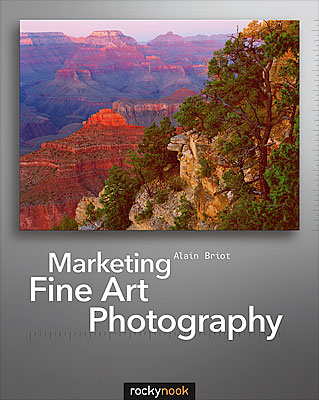
Book Review of “Marketing Fine Art Photography”

August 3, 2011 Marketing, Success No Comments
Briot-FineArt-Marketing-200


Book Review of Marketing Fine Art Photography
a New Book by Alain Briot

What if you had the opportunity to sit down for lunch with a successful fine art landscape photographer, and for one hour, he or she would share their knowledge with you on any one subject of photography you selected.    What might be your area of focus?    Would you concentrate on equipment?  How about favorite locations?  Or perhaps technique or image processing may be your most pressing concern.

Though the opportunity for lunch has yet to materialize, I do find reading the books of photographers a valuable alternative.  If I can get one idea from a book, it is worth the investment of both time and money.  And if I can get a watershed of ideas from a book, then it clearly was worth the price of admission. Most recently I read just such a book.

Alain Briot is a very successful landscape fine art photographer, trainer, and author.  Having read his two previous books, “Mastering Landscape Photography” and “Mastering Photographic Composition, Creativity & Personal Style”, I was most interested in his latest book “Marketing Fine Art Photography”.  This title fit right with what I would ask at lunch, and couldn’t wait until the Amazon order arrived.  I was not disappointed.


For starters, I always read everything with a highlighter.  A good book could easily be frequently highlighted.  With this book, my highlighter ran out before I was finished reading.

Alain is very prophetic early in the first chapter by sharing an old maxim “If you do not market your work, on thing will happen – nothing”.    From that point forward the book opens like the sunshine breaking through the clouds, sharing his mistakes (as he states “these mistakes cost me a lot of time and money”) and successes (which he readily admits work for him, but might not work for you).   Don’t feel bad if not all of your marketing and sales ideas are working, you’ll find out you aren’t alone.

Each chapter is chocked full of information on different aspects of marketing fine art photography.  Sections include selling to wholesale markets (stores), retail markets (internet, art fairs) and consignments (galleries).  Do you find yourself taking a ton of images, only to be bogged down in processing?  You’ll enjoy reading Chapter 4 with its great discussion on quality versus quantity, the two not necessarily being synonymous.  Regardless of the type of photography you shoot, this chapter could easily become the foundation of any business plan.

Not sure how to price your fine art photography?  A complete chapter is devoted to this subject.  Removing the emotion from the pricing discussion, Alain provides a financial analysis method in which to arrive at your price points.  I found this section quite interesting, especially as it related to pricing prints for art fairs with the ‘masterpiece’ setting the pricing mood for the balance of the inventory.

Confused about the difference between marketing and salesmanship?  Alain provides separate chapters on each.  Twenty-six fundamental principles of successful marketing is followed with twenty-six fundamental principles of salesmanship. A third chapter covers the seven fundamental principles of a successful business.   Each of these principles could easily be a stand-alone chapter, and may prompt you into your own further research on the topic.

I find it beneficial when an author includes a resource listing for products and/or services discussed within the book.  Alain freely shares his resource list with the reader, right down to the labels for packaging.

Are you marketing your art as successfully as you’d like?  “Skill Enhancement Exercises” follow each chapter.  This section helps apply the information of the previous chapter.  It may be a small activity or it may be challenging, thought-provoking questions.  In either case, this section provides an opportunity to reflect on what was just read, and how it might relate to the reader’s specific business.

If you are looking for a photography marketing book that can provide many new ideas, yield different viewpoints on some things you may have or are considering trying, and information on ideas that didn’t work, then you’ll find this book well worth the price and time to read it.  There is far more to this book than what I have presented in this short review.  After reading it once, I’ve already reviewed many sections a second time to implement the ideas I want to try. For me, it is one book that I’m very happy to have purchased.

The book is available directly from Alain at this link:

http://beautiful-landscape.com/Articles-Books-3-Marketing.html

As well as on Amazon and other bookstores.

Drake Fleege
Powder Hill Photography LLC
dfleege@charter.net
www.powderhillphotography.com


Coming soon: Advanced Fine Art Marketing Seminar

July 24, 2011 Marketing No Comments

Advanced Fine Art Marketing Seminar — join the pre – registration list for free.

I am opening a pre-registration list for the upcoming Advanced Fine Art Marketing Seminar.  This seminar will be held in 2012 in Phoenix, Arizona.  The seminar contents will be entirely new and different from my book: Marketing Fine Art Photography book.

To sign up simply email me at alain@beautiful-landcape.com with the words ‘advanced marketing seminar’ in the subject line.  There is no obligation to register and no deposit is required.  You will simply be first informed of the exact seminar contents, dates and registration fee.

As a member of this pre-registration list you will receive a special offer price so be sure to register now.  Only members of the list will qualify.

Alain Briot


Search

Loading

NetworkedBlogs Facebook widget